The Thermostat Number Is Not a Room Report
Understand what a thermostat reading represents, compare it with a thermometer, and choose sensible next checks without mistaking a target for a room-wide report.
A thermostat reading describes a control target or the air at its sensor, not the full condition of a heating or cooling system. To interpret the number, first identify which value the screen shows, then check whether the system is responding as expected.
Thermostat readings distinguish a target from a sensor value
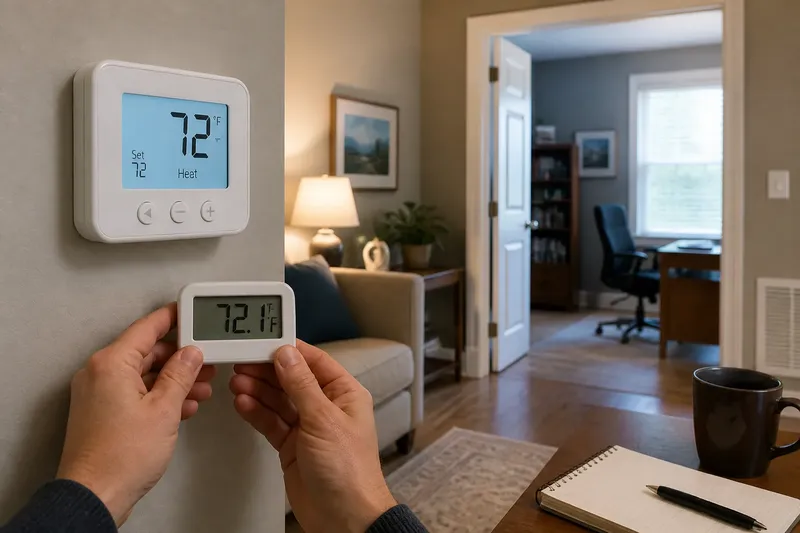
A setpoint is the temperature selected as the control target. A current-temperature reading is what the thermostat’s sensor detects in its immediate surroundings. Some displays show both; others make the distinction less obvious.
Look for labels such as “set”, “target”, “room” or “indoor”, and check the mode indicator. In heating mode, the control generally calls for heat when its sensed temperature falls below the target; cooling mode generally calls for cooling when it rises above it. The exact operation depends on the system and its settings.
If the display gives just one number, consult the thermostat’s manual or manufacturer’s instructions before assuming it is the current temperature. A schedule may also change the target, so check whether the control is following a programme or a temporary adjustment.
A thermostat reading helps explain control behaviour
The thermostat is part of a control loop. Its sensor supplies a temperature reading; the control compares that reading with the setpoint and signals the heating or cooling equipment when needed. Once the sensed condition reaches the control’s target, the call may end, subject to the equipment’s operating logic.
This explains why the system can stop even when the whole building has not reached an identical temperature. The thermostat reports from its own sensor, and the control responds to that input rather than directly measuring every room, surface or occupied area.
Imagine a hypothetical home with one thermostat in a central hall and a study with a closed door. The hall sensor reaches the scheduled heating target, so the call for heat ends while the study still feels cool. The observable result is a satisfied control and a less comfortable study; the next useful decision is to check the study’s air movement and whether the system is designed to serve that room, rather than changing the target repeatedly.
Compare a thermostat reading with a thermometer carefully
A portable thermometer can help distinguish a display question from a local temperature difference. For a fair comparison, place it near the thermostat, away from sunlight, lamps, draughts and supply-air outlets. Let the reading settle, and avoid holding the instrument while you read it.
Then take a second reading in the area you want to understand, using a similar height and avoiding direct sun or moving air. Note whether the system is running, whether a window or exterior door is open, and whether sunlight or cooking may be affecting the space. Different readings from different locations do not by themselves show that either device is faulty.
Use this concrete check sequence to decide what to do next:
- Check whether the screen labels the number as a target or room reading; if it is a target, use the manual to locate the current reading, and if the screen remains unclear, consult the manufacturer’s instructions.
- Check whether the thermostat is in heating, cooling or off mode; if the mode does not match your intended operation, select the appropriate mode using the control instructions, and if it does match, continue checking the schedule and system response.
- Check whether the schedule has changed the target; if it has, decide whether to restore the intended schedule, and if it has not, compare the current reading with the target.
- Check a thermometer beside the thermostat under similar conditions; if the readings broadly agree, treat the sensor’s local reading as plausible, and if they remain persistently far apart, consult the device instructions or seek qualified service.
- Check a second location where comfort is a concern; if only that area differs, investigate local airflow, a closed door or sunlight, and if several areas differ, ask whether the system’s distribution or zoning needs professional assessment.
- Check whether the equipment responds when the control calls for heating or cooling; if it does not, follow the manufacturer’s troubleshooting guidance and contact a qualified HVAC professional where needed, and if it does, allow the system time to respond before adjusting the target again.
What should you check when a thermostat reading seems wrong?
How can I tell whether the number is a setpoint or a room reading?
Look for screen labels, mode indicators and schedule information, then check the thermostat manual. If the device displays only one value, do not treat it as a live room reading until the instructions confirm what it represents.
Why does a separate thermometer show another value?
The instruments may be in different locations or exposed to sunlight, moving air or a nearby heat source. Place them close together under similar conditions before deciding that the thermostat needs attention.
What does it mean if heating stops before every room feels comfortable?
The thermostat may have reached its target at the sensor, while another area remains cooler. Check whether a closed door, restricted airflow or the system’s design could account for the difference; a qualified professional can assess persistent distribution problems.
When should I ask for professional help?
Seek qualified HVAC help if the control’s reading remains implausible beside a nearby thermometer under comparable conditions, or if the equipment does not respond as its instructions describe. Do not move the thermostat or alter its wiring unless the manufacturer’s instructions and your competence make the work appropriate.
Setpoint changes should match the problem
If the occupied area as a whole feels too warm or cool, a modest target adjustment may be reasonable. Allow time to observe the response. If the discomfort is confined to one spot, first check local airflow, a nearby open door or window, and whether sunlight is affecting that area.
Constantly adjusting the setpoint for brief changes is not worth the effort. A short-lived shift after cooking or opening a door may pass without intervention, and repeated changes make it harder to identify the control setting that suits the space.
For a useful thermostat reading, keep the distinction clear: the setpoint is the target, while the current reading belongs to the sensor and its location. That difference helps you decide whether to adjust the control, investigate a local condition or ask a professional to inspect the system.