A Quiet Room Check Before the Season Turns
A quiet room check helps you trace persistent room discomfort to its timing and location, giving you clearer notes to share with an HVAC professional.

A quiet room check can show whether discomfort follows a particular activity or condition, rather than the room itself. Before changing settings for the season, use a quiet room check to record what happens during ordinary use and give a heating and cooling professional a clear account if a problem persists.
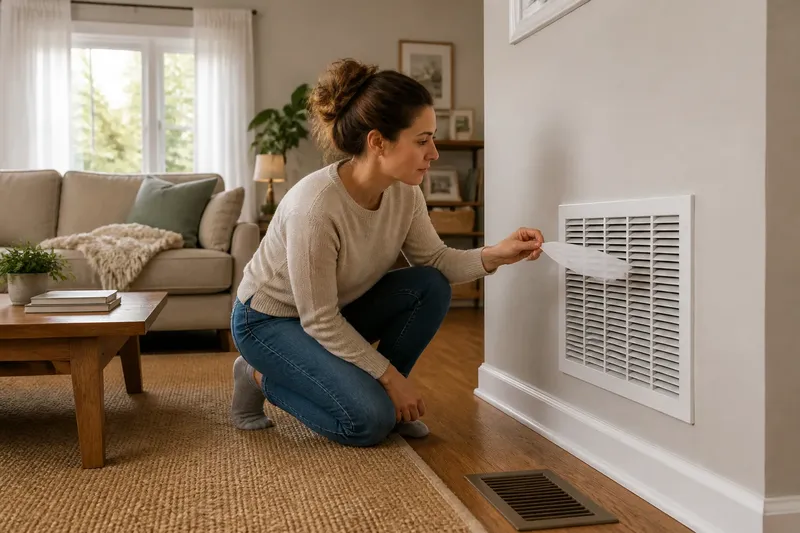
This is a comfort check, not a system diagnosis. Keep to visible, accessible areas and the controls’ normal display. Do not remove panels, reach into grilles or try to provoke a fault.
Record what the room is doing
Choose a time when the room is being used as usual. In a notebook or phone note, write down the room, time, whether the heating or cooling seems to be running, and what is happening nearby. Sun on a desk, a cooking appliance, a closed door or an unused room can all help explain a change in how the space feels.
Use a simple route and describe the room’s use, not just its temperature. For instance, note whether you are sitting still, working at a desk or moving about. The aim is to identify when discomfort interrupts an activity, not to produce a map of the room or a reading of every corner.
Say you are working at a desk near a sunny window and feel uncomfortable. Note that the discomfort starts while sunlight falls on the desk, and whether it eases when you move to your usual chair elsewhere. The resulting note links the sensation to a specific activity and condition; it does not establish its cause.
Track interruptions and room use
For each observation, record what changed just before the room became uncomfortable. Did someone open a door? Did cooking begin nearby? Did the room fill with people, or did you move from a quiet task to more physical activity? These details can help distinguish a recurring interruption from a general comfort problem.
Note how long the discomfort seems to last in ordinary use, without timing it precisely. Record whether the room becomes comfortable again after the activity or condition changes naturally. Do not alter the household routine solely to produce a comparison.
What is not worth the effort is logging every passing sensation or trying to assign a technical cause to each one. A short note about a recurring disruption is more useful than a long diary of guesses.
Describe comfort in terms of the activity
Use plain descriptions such as comfortable, distracting, stuffy or difficult to work in. Add what you were doing and where you were, then say whether the feeling affected the task. This makes the note useful to someone who needs to understand the room’s practical problem.
If another person uses the room, ask what they noticed during the same ordinary activity. Record their account separately rather than assuming everyone experiences the space in the same way. Differences may relate to clothing, activity or personal comfort, so they are context, not proof of a system fault.
For a room used at different times, compare similar activities rather than treating morning work and evening relaxation as equivalent. Include obvious changes, such as a sunny window or a busy kitchen, so a professional can see which conditions may matter.
Check the controller’s schedule without changing it
Look at the thermostat or controller display and note the mode and any schedule, hold or timer indication you recognise. Copy the displayed wording if you are unsure what a symbol means. Consult the device instructions rather than guessing.
Ask the person who manages the settings what the intended schedule is, if that is not you. A room may feel different because its use does not match the active schedule, but the display alone cannot tell you whether the system is operating correctly.
Avoid changing several controls to see what happens. If a setting needs adjustment, follow the device instructions and change only what you understand. If the intended schedule is unclear or the controls behave unexpectedly, ask a qualified heating and cooling professional for advice.
What should you note before asking for help?
What details help explain the problem?
Write down the room, what you were doing, what made the room uncomfortable and whether the same situation has recurred. Add any relevant activity nearby, such as cooking or a door being opened.
Should I record other people’s experience?
Yes, if they use the room; keep their description separate from yours. Different accounts can clarify which activities or parts of the day are affected without proving a particular cause.
What if the schedule is unclear?
Record the controller’s displayed words and ask whoever manages it what the schedule is meant to do. If its instructions do not explain the display, contact a qualified professional rather than changing settings you do not understand.
When should I stop checking?
Stop and seek appropriate help if you notice smoke, a burning smell, an unusual loud mechanical noise or another immediate safety concern. For a suspected gas or electrical hazard, follow local emergency guidance and contact the relevant qualified service; do not investigate the equipment yourself.
Keep a concise record of the pattern
Use one line for each recurring interruption: the activity, the condition, the discomfort and whether it eased when circumstances changed naturally. For example, “Working at the desk; sunlight on the work surface; discomfort eased after moving to the usual chair.” This describes an observation without claiming that sunlight or the system caused it.
Share the notes with a technician if the problem keeps affecting how the room is used. Include the controller display and any relevant schedule information, but separate those facts from your suspicions. A qualified professional can decide whether further assessment is appropriate.
A quiet room check is most helpful when it focuses on the room’s use and the moments comfort breaks down. Keeping that distinction in your notes gives the professional a clearer question to answer, while leaving diagnosis and equipment work to someone qualified.