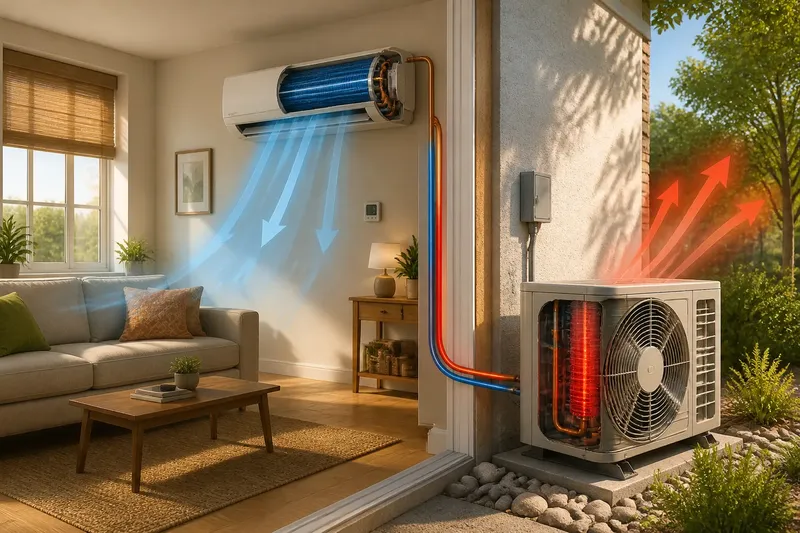
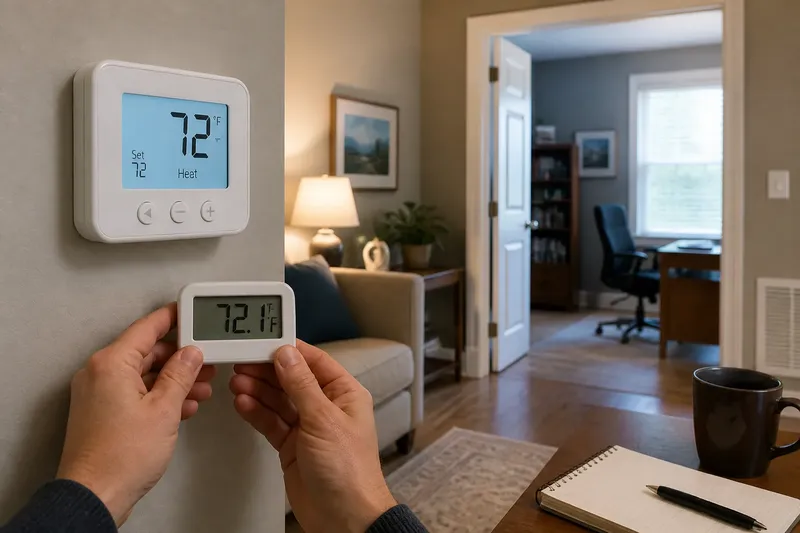
Supply Vent or Return Vent: Two Different Jobs
Supply vent or return vent? Learn how to tell them apart, understand each role in room circulation, and decide which opening to keep clear.
A supply vent or return vent can look like a simple grille, but the two openings move air in opposite directions. A supply vent delivers conditioned air into a room; a return vent carries room air back towards the heating and cooling equipment. Knowing which is which helps you understand the path air is meant to take and avoid blocking the wrong opening.
Start with the direction of airflow
In a typical forced-air system, a fan moves air through ductwork. The supply side sends air from the equipment into the rooms. The return side draws room air back to the equipment, where it can be filtered and heated or cooled before being sent out again.
The grille is the visible end of an air path, not the whole system. A supply duct connects to the supply outlet; a return duct connects to the return inlet. Both matter: air needs a route into a room and a route back out of it.
“Vent” is often used for either grille in everyday speech. Some people call supply outlets registers, especially when they have adjustable slats, and call return grilles simply returns. Those terms are not perfectly consistent, so identify an opening by its airflow and location rather than its name alone.
Choose by what you can observe
If you need to identify an opening, use its position and the direction of air as clues. A supply outlet commonly sits in a ceiling, wall or floor and blows air into the space. A return grille is often larger, may be on a wall or ceiling, and draws air inward. These are common arrangements, not rules: buildings vary, and grille size by itself does not settle the question.
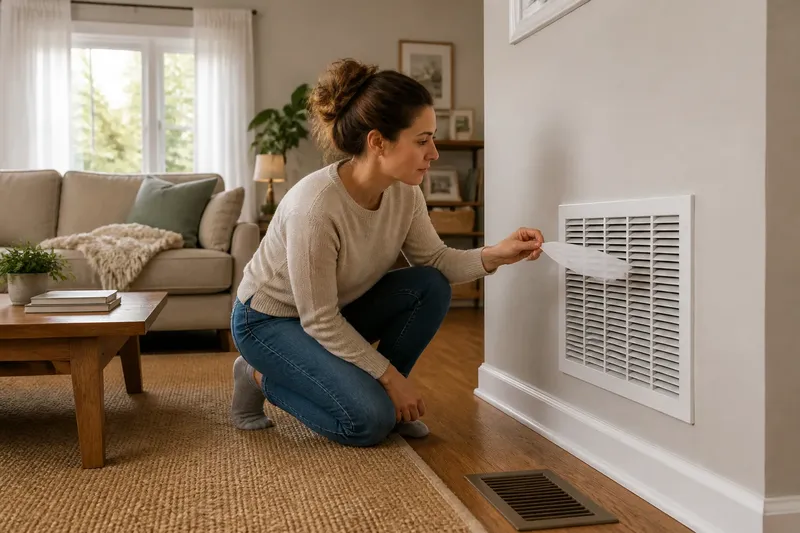
With the system running normally, hold a light strip of tissue near the grille without covering it. Movement away from the grille suggests supply airflow; movement towards it suggests a return. Keep your hand, paper and other objects clear of moving parts, and do not remove a grille to inspect ductwork. If the result is unclear, a system label, building plan or HVAC professional can help identify the opening.
Say you are unsure about a broad grille in a hallway. Imagine the fan is running and a tissue held nearby is drawn towards the opening. That observation points to a return grille, so you would keep that area unobstructed and avoid treating it as a place to direct air into the hall.
Match your situation to the right opening
- If air is blowing into the room: treat the grille as a supply outlet. Keep its face open so air can enter, and adjust its louvres only if they are designed to move.
- If air is being drawn in: treat the grille as a return. Leave space around it for air to reach the opening rather than placing furniture or fabric against it.
- If you are deciding where to place furniture: avoid putting a tall bookcase, sofa or curtain directly over either type. For a return, obstruction limits the path back; for a supply, it can deflect the outgoing air and leave nearby areas feeling uneven.
- If you are looking at a grille while the system is off: do not infer its role from still air alone. Check again during ordinary operation, or look for a building diagram or ask the person responsible for the system.
- If a grille seems to serve a different purpose: some rooms have exhaust openings, such as bathroom fans, that carry air outdoors rather than back to the central system. Do not assume every grille belongs to the supply-and-return circuit.
It is not worth repeatedly opening and closing supply louvres to correct a room that feels uncomfortable. The grille’s position and design may not allow useful balancing, and changing one outlet can affect the rest of the system. Start by identifying the airflow path; leave system balancing to an appropriate professional when the cause is not clear.
Keep the room’s return path open
A supply outlet can deliver air to a closed room, but that air still needs a route back towards a return grille. In some homes, the route is a gap beneath a door. In others, there may be a transfer grille or return duct serving the room. When a door is shut and the path is restricted, airflow through that room can change, even though its supply vent remains open.
This is why a room can have a visible supply grille but no return grille of its own. The system may rely on air moving through the doorway or another designed route. A gap that looks incidental can be part of the circulation path, so avoid blocking it with a draught excluder or a thick rug without considering how the room is ventilated.
A return grille also needs clear space in the room it serves. A bookcase pressed against it, a curtain hanging over it or a pile of laundry can obstruct the inlet. The useful question is not simply “Is there a vent?” but “Can air travel from the occupied part of the room to the return opening?”
Know what supply and return grilles do not do
Neither grille creates conditioned air. The supply opening is where air enters the room, while the return opening is part of the route back to the equipment. A return grille does not usually blow cool or warm air into the space, even if it is connected to the same central system.
Grilles are also not interchangeable covers. Putting a filter in a return grille may be appropriate in some systems, but adding one where it was not intended can impede airflow. A filter belongs in the location and type specified for the system; follow the equipment instructions or ask a qualified HVAC professional if the intended position is uncertain.
Likewise, closing a supply outlet is not the same as redirecting the return path. A return needs access to room air, not a directed stream from a vent. If a room is uncomfortable, a blocked opening is one possible clue, but the issue could also involve the system, the room layout or how air moves between rooms.
Which vent am I looking at?
Can a return vent blow air?
In a conventional forced-air arrangement, a return draws air towards the system rather than supplying it to the room. Air movement can be hard to sense at a large grille, so use a tissue near the face while the fan runs normally if you need a simple clue.
Does every room need a return vent?
No. Some layouts use a return grille in a central area and allow room air to travel back through doorways or transfer openings. The design varies, so a room without a visible return grille is not automatically missing one.
Should I close a supply vent in an unused room?
Do not assume that closing it will improve comfort elsewhere. Central systems are designed around their ductwork and airflow paths, and changing outlets can alter how air moves through the system. For repeated comfort problems, ask a qualified HVAC professional to assess the arrangement rather than making broad changes to the grilles.
Why is air coming from a grille I thought was a return?
The opening may be a supply, or the system may have a different configuration from the one you expected. Check the direction while the system is operating and look for a plan or label that identifies the duct. If airflow remains puzzling, have the system identified rather than relying on the grille’s size or location.
Read the pair as one circulation route
To understand a room, trace the intended route: conditioned air comes from a supply vent, spreads through the space, then reaches a return opening directly or by travelling through a doorway or transfer path. Supply vent or return vent is not a choice between two versions of the same fitting; each marks a different part of that route.
For everyday decisions, identify the direction of airflow, keep both openings clear and notice whether a closed door might restrict the route back. Those simple observations help you describe the system accurately and give a professional a clearer starting point if the room continues to feel uncomfortable.